
Eve Maret transcends convention.
The Nashville-based musician and sound artist challenges the listener to follow her work as it takes numerous branching paths. It is a journey well rewarded with a procession of enriching listening experiences.
Maret’s compositions span dance, pop, funk, and electronic music on one end, and offer works of sound art on the other.
It is a multidisciplinary repertoire that is uniquely her own.
Maret’s latest release, Evergreen, marks another new layer in this unique body of work.
Released in March, Evergreen stands intertwined with Maret’s sound-healing practice — enabling others to overcome illness and struggle with the help of sonic meditation that can anchor the listener, reduce stress, and increase mindfulness.
The recording combines tones from a synthesizer with those sourced from one of the artist’s most precious physical spaces. Sharing a piece of herself, Maret reaches out to the listener, offering a calm, gentle voice to provide peace and encouragement — a gift that helps those listening find a clear path forward.
Between a series of performances in Nashville, Maret took some time to speak with us about this new project, released with the Austin-based label Aural Canyon.
This conversation has been lightly edited for clarity.
❖ ❖ ❖
Sound Dissection: When did you conceive of Evergreen? Did it begin as a concept project, or did the compositions or experiments you were making lead you to it?
Eve Maret: I’d been doing sound baths at venues around Nashville since 2023, and one of my best friends said that if I made an album of purely ambient music, she would listen all the time. Her encouragement sparked inspiration within me to record an album in the same fashion I perform sound baths.
This new endeavor is deeply rooted in nature and the natural world, both in theme and through the inclusion of field recordings. What is your relationship with nature? How does that relationship relate to the process of making music?
Being in nature feels similar to the state of flow that I’m in when making music. When I’m in nature and when I’m creating, there is a suspension of thought and a pureness of being that is directed by a force greater than myself. I am fully present.
Can you walk me through the production process of Evergreen? When and how did you make these compositions? Did you work in a studio environment or at home?
I started the recording and production process in late July 2024. However, I began gathering inspiration a few weeks prior. When I was touring in the UK, I had a day off in a small town called Tynemouth. I spent time on the beach, completely alone with the crystal-clear water. I wanted to carry this feeling into the music I’d make upon returning to the States. The titles “cullercoats” and “meadowell” also come from my UK tour. They are other picturesque towns I explored. The field recordings I used came from a vacation a few weeks later to Lake Michigan, which has been a place I’ve had a relationship with since birth.
What compelled you to include that additional layer of field recordings to the music? Also, can you let me know why Lake Michigan is such a special place to you? How does it make you feel to be there?
While I was vacationing there with my mom, I had already begun the recording process for Evergreen, and it seemed like a perfect opportunity to enjoy the setting while also gathering material I could implement later. Lake Michigan is a special place to me because I was born in close proximity to the water. I arrived early and unexpectedly — while my parents were on vacation. It was like I was choosing this specific place for a reason. My family has had a tradition of returning to the lake year after year, and being there always feels like a return to myself, a rebirth.
How do these experiences translate into music for you? Is it the emotional experience of being in these places that is replicated in the music? Where do the place and the composition meet for you?
My music always comes from an intuitive and emotional place. I hope listeners are immersed in the feeling I’m embodying at the time of the inspiration and execution. It’s not always inspired by a physical place — it can also be a psychological or imagined place. In the case of Evergreen, much of the inspiration came from the emotional experiences of being in beautiful places that brought me a sense of peace.

Are you using the Moog exclusively on this recording, or are there other tools in use as well?
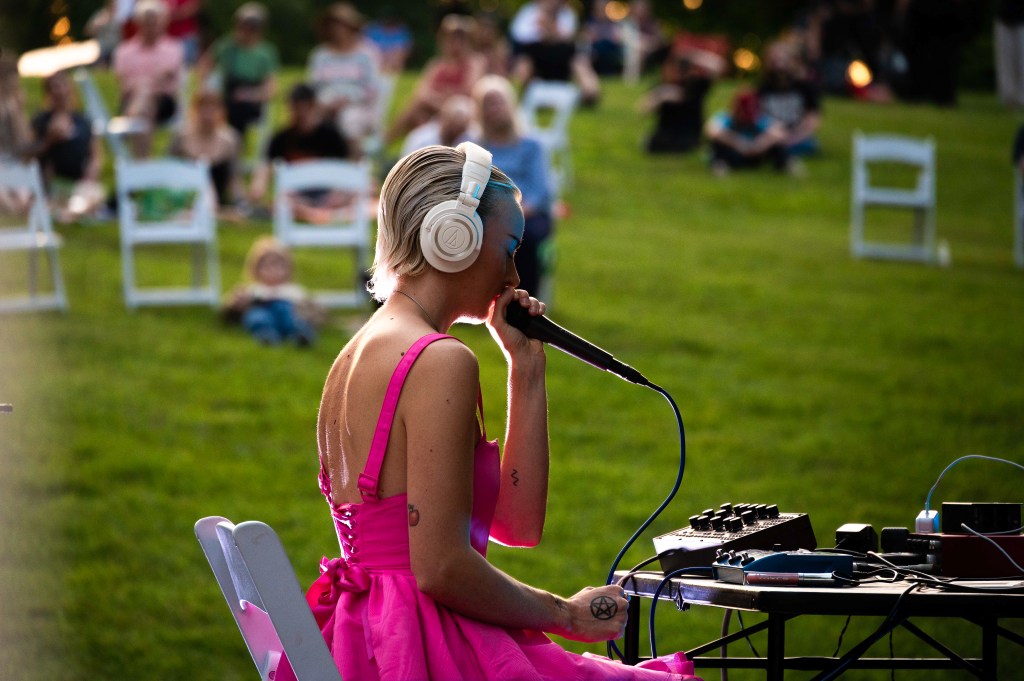
The tools I use on this recording are the Moog Mother-32, the TC Helicon VoiceLive Play (for vocal effects and looping), and the field recordings. I gravitate toward the Moog, the vocal effects pedal, and whatever field recordings I intuitively select.
There is mention that you used a Moog Mother-32 synthesizer as the basis of the project. What drew you to this instrument, and why was it so integral to this work?
I happened upon the Moog Mother-32 by chance in 2022. I was set to perform at a music festival called Witching Hour in Iowa City, and Moog invited me to facilitate workshops for the public with the Mother-32 and DFAM. I had no experience with either synth, and they kindly sent me both. The Mother-32 is a robust synthesizer with lots of possibilities for sequencing and modification, and yet I found that it’s a very effective tool for a droning bass sound that can be easily shaped.
What is your opinion on using traditional analog tools versus computer-based platforms and toolsets? Does each tool significantly change the creation process and ultimately the final work?
All synthesizers, whether analog or digital, are valid and equally great in my opinion. However, using AI to create music is a problem. The purpose of music, to me, is to express the nature of one’s soul. When a song is generated by AI, all of the emotion and content of the soul is lost. There’s an eerie form of false consciousness that cancels out the humanity that is central to music. That being said, the tool being used for creation definitely influences the process, which then determines the end result — just like the choice an artist makes to use oil paint versus acrylic. Different tools lend themselves to different results. The more the creator allows their touch to interact with the tool in a unique and specific way, the more the end result will reflect that person back to them.
Evergreen feels like a shift from your more dance-centered music. What compelled you to move in this direction?
I often vacillate between moods and genres. I feel a wide variety of emotions, and I think some genres express certain moods more effectively than others. I don’t want to lock myself into any particular set of sounds — I want to explore them all. For instance, I think there’s a part of myself that is laid back and peaceful like the ambient music I make, and there’s a part that is fun and excitable like the dance-centered music. I wanted my catalog to reflect the variety of sounds that I make and perform live.
Although it varies greatly in style, all your music is listed under Eve Maret. What compelled you to work like that instead of building individual identities for each project?
I choose to have all of my music under my name because I am a musician who identifies as an artist and composer. I’m not interested in limiting my music to a specific brand or packageable idea. I want people to see it’s okay to own being multifaceted and to follow your inspiration — wherever it leads! Plus, it would be far too time-consuming to create individual identities, which would leave less time for making music.
You also have a sound-healing practice. Can you share more about what that is? How much does Evergreen coincide with that discipline?
I facilitate sound baths for individuals from my home studio, and I also bring them to music venues, meditation groups, drug and alcohol detox facilities, and sober-living houses for people in recovery. The setup is identical to how I made Evergreen. I use the Mother-32, my voice, and field recordings. I intuitively make sound with this setup and allow myself to be guided to what feels right in the present moment.
Could you share how sound healing has helped you and those you work with?
Sound made with intention has an immediate healing effect. In addition, sound has a unique way of accessing parts of us that are deep and unconscious. I believe it’s a primal connection, one that predates language. Sound transforms lives. I have definitely witnessed sound elevate every aspect of my life — my health, my happiness, my spiritual relationship, and my relationships with others. It is a powerful tool for self-expression and self-healing that can alchemize blocked energy into a portal of wellness. I feel so grateful to witness others tap into their own healing abilities through sound.
Unlike your other work, Evergreen was released through the Austin-based Aural Canyon label. Can you share some insight into how that relationship formed?
Absolutely! I reached out to my friend Cynthia Bernard, aka Marine Eyes, who is an amazing multidisciplinary artist and musician. I asked her for ambient label recommendations, and she generously introduced me to Matt at Aural Canyon. After getting to know the label and talking with Matthew, I felt confident it would be a good home for Evergreen. She also created the album art!
Speaking of the album art, it is really something special. Can you tell me how that came about? Did you describe your vision to Cynthia, or did she create it on her own?
Agreed! I’m in awe of her artistry. The only input I gave Cynthia was that I’d like the result to be green in color. From there, she sent me numerous options for the art she had created. The one we went with came about through an experimental process involving photography and painting on glass.
You are based in Nashville. As a whole, the music you create does not align with what most people think of the city, dominated by country music and its many forms. Does the community still provide a place for artists that cater to more unconventional tastes?
While country is the dominant genre here, I believe Nashville is a great place for musicians of all kinds. When I first started performing live and releasing music, I was amazed by the amount of support I received, as well as the collaborative spirit of the experimental community. In a way, I think there’s a unique opportunity for those of us in the less conventional scene to have a greater impact and to build something distinctive. From my perspective, as more people move here from around the world, the music scene becomes more diverse.
Would you be willing to share your thoughts on the city and its relationship with music and creativity? Could you consider it a nurturing environment for artistic pursuits, especially in music?
In many cases, people move here because they want to pursue music — myself included. Nashville has a long and rich history of nurturing creative people, including my personal favorite, Jimi Hendrix, who lived and played here before launching into stardom. Although there are many benefits to being a musician here, historical venues have been erased and taken over by developers who have no respect for the culture that came before them. My hope is that the city can grow from a place of intentionality, from acknowledging and honoring its history — one that was trailblazed by people of color. I’m grateful to live in Music City. It’s the place where I decided to fully devote myself to being a creator, and I wouldn’t have chosen any other place.
