
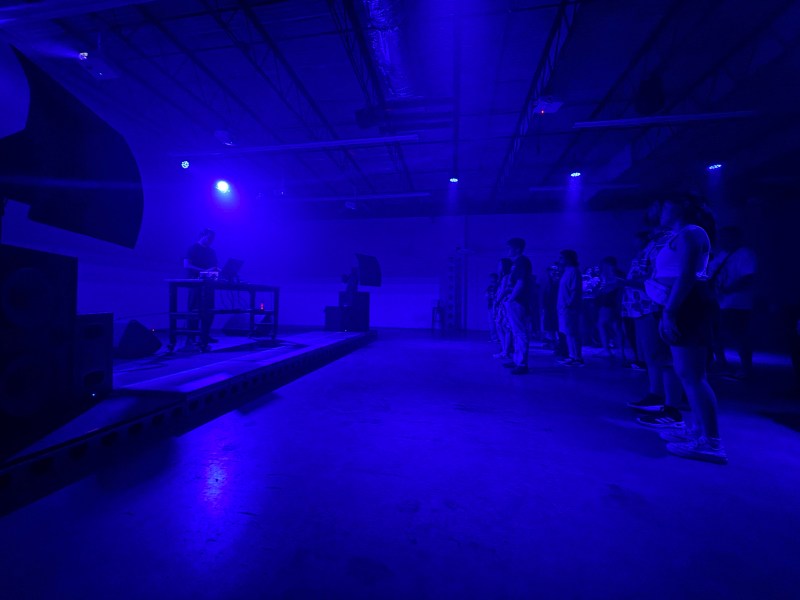
An intricate wall of electronic timbre and a pulse of blue light filled Austin’s dadaLab as the Budapest-based artist performed a carefully crafted, unpredictable form of club music and visual design.
The set from Gábor Lázár centered on a series of intricate polyrhythms that moved in and out of sync with one another, creating a shifting interplay between musical chaos and order. These beats, bathed in the cool hue that dominated Lázár’s lighting design, were analogous to an image bleeding in and out of focus in a camera’s viewfinder.
When presented alongside the night’s fellow performers, the local dance-forward rhythms of Joan Dark and Blend Mode, Lázár’s work read as drastically minimal and theoretical.
The Mach 21 performance, the second stop on Lázár’s 2026 tour of the United States, served as a kind of musical deconstruction. The performance concentrated entirely on rhythm and pulsating blue blocks of light. These elements were perpetually woven in and out of sync with one another as they swept through the large room industrial space, which appears to have been initially intended as a loading dock.
Much of the evening’s performance appeared tied to the artist’s 2024 album Reflex, a collection of percussion and synthesizers grounded in techno, but an investigation of the plasticity of sound that challenges conventional musical structure.
With such unpredictable rhythms, Lázár’s set turned the night inward for the audience, creating a shared space for meditation and self-reflection. This stood in direct contrast to his peers, who offered a more direct communal dance experience.
This combination made for a contemplative and multidimensional experience.
It is a characteristic that has come to define many recent performances at Austin’s dadaLab. The creative operation has been offering a series of meticulously curated events that take a holistic approach to musical performance, with a focus on immersive environments centered on lighting design and rigging.
The organization, which places a heavy emphasis on education and community building, has called a commercial building at 2008 Alexander Avenue its home for the past three years, serving as an anchor for Austin’s technology-focused artist community.
Lázár’s visiting performance, accompanied by dadaLab’s infrastructure of floor-to-ceiling projections and immersive lighting, offered a meditative examination of the foundational elements of electronic dance music.
The performance made clear the unique timelessness of this practice. Although executed with highly advanced software and an impressive collection of hardware, the performance — at its core — is a form of human communication that predates any spoken language. Beneath the guise of spectacle and amplification remains an eternal echo, reflecting the origin of being.
