
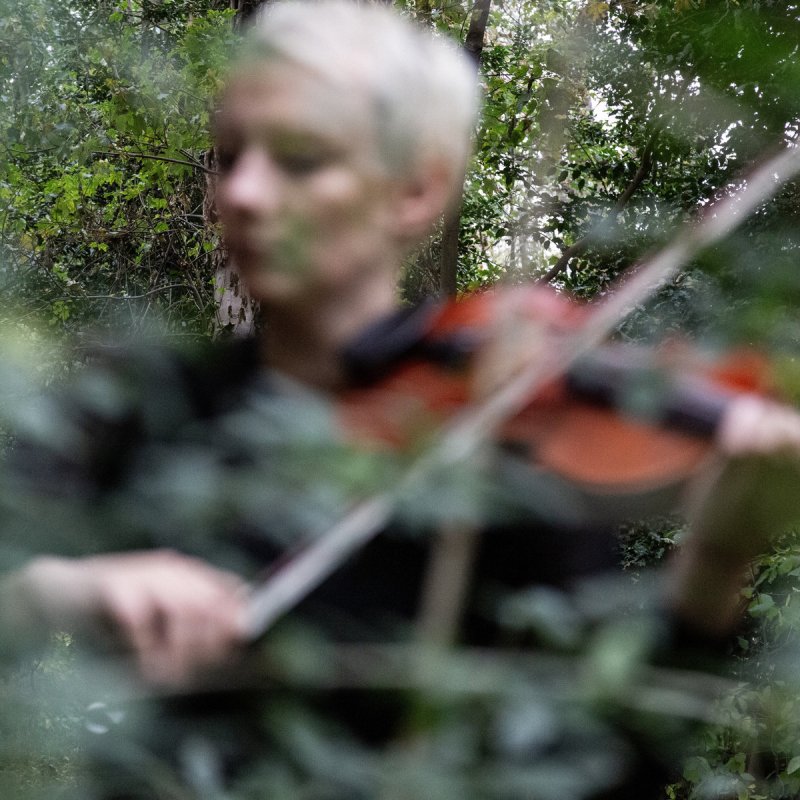
Magda Drzod has crafted a musical experience that captures the gentle magic of the natural world at twilight. It is a creative undertaking that places the listener directly between the final light of day and the first stars emerging in an ever-darkening sky.
The project has taken shape as an eight-song album, Divided by Dusk. The recording, available in physical form through Bandcamp, was released in April by Präsens Editionen, a Lucerne, Switzerland-based community publishing project.
The album offers a sound that seems buried deep within a lush green forest. It brings the listener into this place and allows them to rest within it, suspended between the end of day and the onset of night.
Just as the work explores this temporary state between two conditions, the recording itself balances traditional composition with experimental, improvised textures.
It blends Drzod’s string performances with electronic synthesizer textures. Taken as a whole, the album combines structured composition with atonal and cinematic expression, forming a vivid artistic metaphor for its subject.
Divided by Dusk draws on the artist’s deep appreciation for Japan and its experimental music traditions, alongside the folk heritage of Drzod’s native Poland.
Together, these influences establish the album’s foundation.
Its heavy echoes and wildlife sounds transport the listener to a space that feels suspended between dimensions. The music carries the listener somewhere unfamiliar, untamed and unclassifiable.
Drzod’s string work and choral techniques anchor the production, adding a human presence to its celestial atmosphere.
Electronic textures expand the album’s dynamic range, reaching from rumbling lows to quivering highs.
“Eclipse” introduces the twilight setting with deeply reverberating tones that evoke the uncanny nature of the moment. Sampled crickets and other nocturnal sounds signal the transition into this liminal state, where the world briefly becomes something else entirely.
The title track follows, drawing the listener deeper into the sonic landscape. A choral vocal passage gives way to a prancing violin or viola line, propelled forward by rhythmic accompaniment.
“Contrasts” continues as the light fades further. A steady drone grounds the piece while fluctuating textures envelop the listener, mirroring the encroaching darkness.
“Rounds” invites exploration. Water droplets fall as nocturnal activity stirs. Here, Drzod’s interest in Japanese traditions becomes explicit with the inclusion of the shinobue, a side-blown bamboo flute performed by Rai Tateishi. Additional contributions include recording and mixing by Koshiro Hino.
Despite the ominous setting, the piece remains meditative. It reflects the work’s dual nature as both performance art and composed music.
“Piosenka Ludowa,” Polish for “folk song,” firmly roots the album in an ancient, almost otherworldly space. While it begins in a traditional form, it gradually dissolves into a realm of clashing tones, reinforcing the album’s departure from convention.
The album moves deeper into night with “Hungry Nightmare.” Drzod’s fiddle fades as a trumpet-like sound draws the listener further into darkness. The piece carries a sense of both romance and danger.
“Vertigo” marks the full arrival of night. Echoes and strings create unease as tension builds.
That tension resolves in “From the Depths,” which suggests acceptance of the night. A choir sings in the artist’s native language, accompanied by strings, underscoring Drzod’s connection to folk traditions.
The closing passage signals the end of the journey through this liminal space. The unease and tension of the transition subside, though only temporarily, before the cycle begins again.
