

Transience has become a defining feature of modern existence.
The vast majority of products that consumers — people — use today are designed for short lifespans. We wear inexpensive clothing meant to survive only a finite number of laundry cycles while brands introduce new styles weekly. The 24-hour news cycle develops stories rapidly, only to abandon them just as quickly. The phones we use to consume that news are constantly updated and replaced with sleeker versions boasting higher-resolution displays and, sometimes, longer battery life.
The cost of transportation and the rise of multinational corporations in recent decades have made it possible for individuals to make a living across the globe with relative ease. That same instability ensures that, at times, people must pack up quickly and relocate to pursue or sustain their careers. We move into newly constructed buildings and criticize them for poor craftsmanship, lower-quality materials and rushed construction timelines.
As we transition from place to place, we often become less connected to those around us. We lose track of our neighbors. We don’t know who our mayors are or who represents us in local government.
We refer to fledgling romantic relationships as “situationships,” a term that often evokes anxiety rather than excitement or joy.
There is perhaps no stronger representation of this impermanence than a modern transit center. Whether at John F. Kennedy International Airport in New York or Beijing Capital International Airport, travelers pass through these spaces prepared to move thousands of miles in a matter of hours.
Japan’s Shinjuku Station in Tokyo serves more than three million commuters daily, while Howrah Station in India supports roughly one million travelers, and Gare du Nord in Paris sees about 700,000.
Whether across the globe or downtown for work, we are all going somewhere, often with little concern for where we are at the moment.
Amid record-setting high temperatures on May 15, 2025, cellist Lia Kohl walked into Union Station in downtown Chicago during rush hour and began to play. The act addressed this reality directly, offering — if only momentarily — a sense of respite.
Kohl was joined by nine musicians: Dorothy Carlos, cello; Zachary Good and Jason Stein, bass clarinet; Gerrit Hatcher, tenor saxophone; Riley Leitch and Nick Meryhew, trombones; Beth McDonald, tuba; Zach Moore, bass; and Macie Stewart, violin.
As composer and director, Kohl and her collaborators performed a slow, meandering piece within the bustling hall, offering a pause from the often emotionally vacant process of commuting.
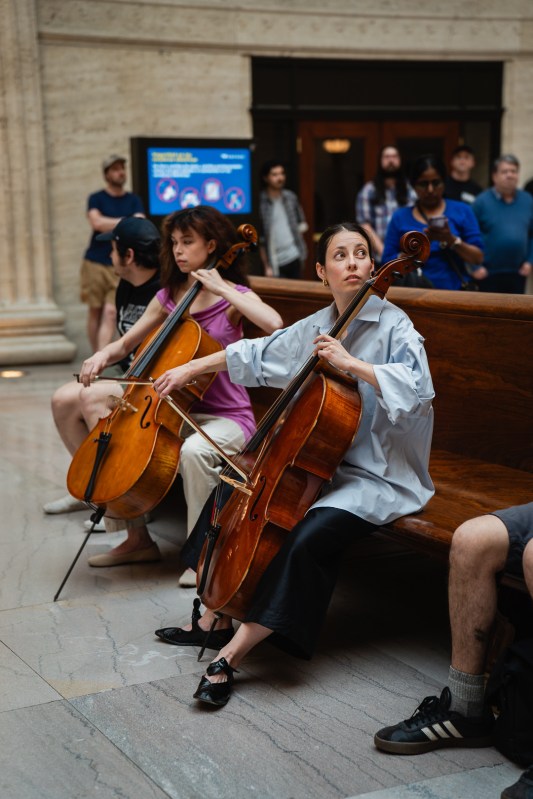
(Ricardo E. Adame | @ricardoeadame)
Regional mass transit — especially rail service — is essential to the health of large metropolitan areas, providing a more sustainable and community-centered mode of transportation. That reality remains unquestioned. Still, the symbolism of the space is potent.
Released as a recording on Jan. 16 through the Rome-based label Superpang, Music for Union Station is a carefully mixed document of Kohl’s performance, edging closer to performance art than traditional symphony.
The first sound introduced during the 43-minute recording is not Kohl’s cello, but the ambiance of Union Station’s Great Hall — the collective drone of a crowd moving through the historic building, completed in May 1925 in the opulent Beaux-Arts style.
Footsteps, chatter and the cry of a baby are heard before an Amtrak employee makes an announcement. Gradually, the ensemble’s whispers swell and overtake the listener’s attention.
PHOTOS: Music takes over the Great Hall at Chicago Union Station
The ambient sounds of the station remain a central instrument throughout the recording. The squeak of sneakers on stone floors, the thud of a suitcase dropping, and the sharp horns of baggage carts rushing through the hall provide a textured counterpoint.
This fast-paced environment exists in juxtaposition with the slow, meditative piece scored by Kohl. Throughout the recording, the two elements remain intertwined yet fundamentally opposed.
Occasional sniffles, the distant ringing of mobile phones and the clicks of passing cameras add further texture. The musicians can be heard moving throughout the hall, their shifting positions emphasizing the space’s immense natural reverberation. At one point, a saxophone blares from across the station, underscoring the scale of the room.
By blending ambient music, field recording and live performance, Kohl documents the sound of our physical, economic and spiritual transience — and transforms it into something contemplative and engaging.
Like all masterfully created art, the work invites analysis, criticism and, most importantly, emotional response.
Through Music for Union Station, Kohl and her collaborators hold up a mirror to each of us, forcing a confrontation with the values we prioritize.
Will I get there on time?
How can I make the best impression?
Was I passed over for that promotion?
When can I afford that new car?
Is the next update really that important?
Did I say “I love you” this morning?
When was the last real conversation I had?
Am I doing enough to leave the world better than I found it?
These questions linger as the final notes of Music for Union Station fade. And, as it began, the sound of the bustling hall — its countless footsteps and anonymous chatter — slowly dissolves, leaving the listener alone with their thoughts and, if only briefly, a sense of peace amid the noise.
