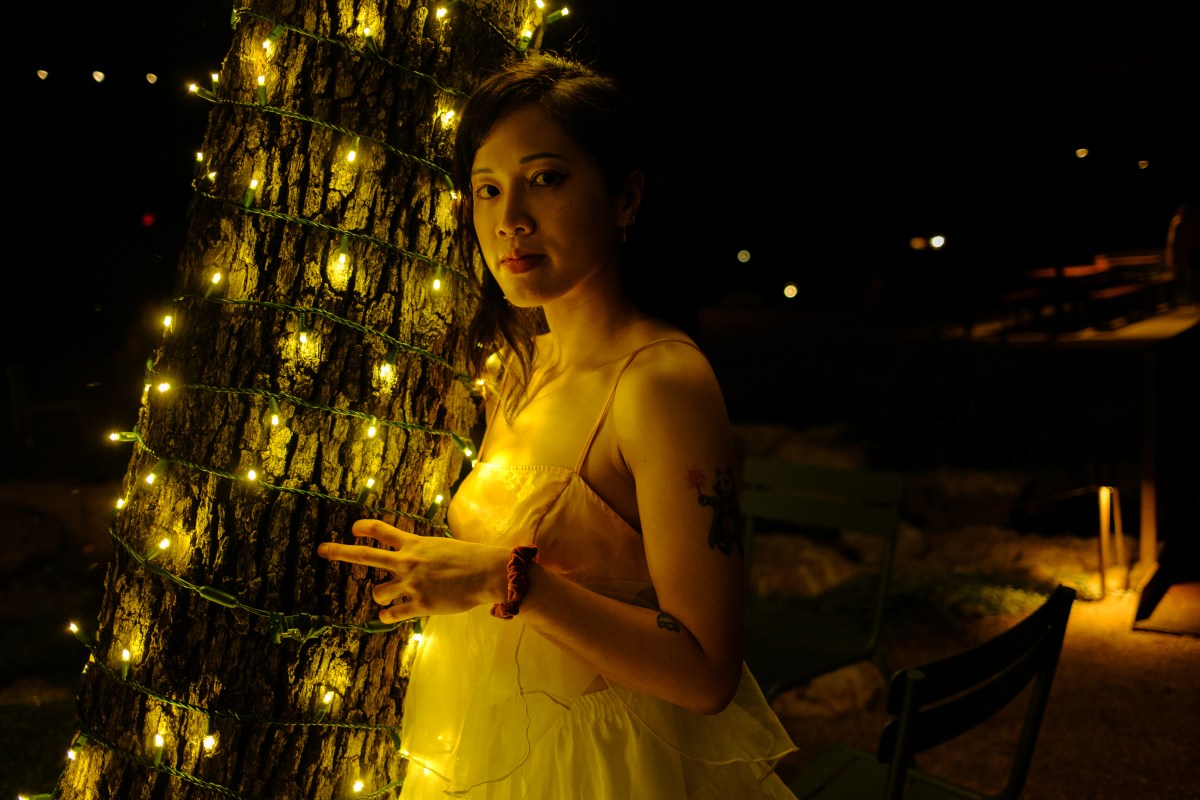
Hexpartner is a musical undertaking that is steadily building upon the intersection of traditional classical composition and the darker elements of post-punk and new wave.
The project, a solo endeavor by the artist and physician Grace Sydney Pham, has woven a musical tapestry that evokes medieval fantasy and religious practice in a fictional world of unending strife.
Hexpartner is as much a work of storytelling as it is a document of Pham’s own journey with faith and Catholicism.
Combining traditional choral singing, harp and modular synthesizers, the project offers a soundtrack that blends seamlessly with the autumn season. As cool winds and a transforming landscape offer an artistic forecast of the cold winter months ahead and the deep darkness that comes with it, the music of Hexpartner carries listeners to a similar atmosphere.
Pham, a practicing psychiatrist, describes their music as neoclassical darkwave, sourcing inspiration from the pieces they played growing up in church, the 12th-century German Benedictine abbess Hildegard of Bingen and the Gregorian chant that emerged during the Carolingian Renaissance in the 8th and 9th centuries.
The British-Australian duo Dead Can Dance remain one of Pham’s most influential contemporary inspirations and fellow champions of the musical aesthetic upheld by Hexpartner.
After formally launching the project in 2023, Pham has shared stages with many collaborators, including the film composer Graham Reynolds at Austin’s dadaLab for a performance held in association with the acclaimed Fusebox Festival.
Showcasing Pham’s extensive range and pursuit of simultaneous musical traditions, Hexpartner has also opened for Mortiis, a Norwegian artist recognized as an originator of the dungeon synth genre. Although working in lockstep with that subcultural tradition, Pham shares that their interest in that scene has soured.
Instead, Hexpartner has kept their focus on participating in as many performances as they possibly can, from songwriter rounds to fully scripted audio-visual experiences. With more than 70 appearances last year alone, that mindset has resulted in the project’s permanence throughout much of Austin’s electronic, alternative and experimental music scenes.
Released in January, Hexpartner’s latest album Requiem marks a certain culmination of Pham’s musical trajectory. It builds upon the artist’s interest in the darker aesthetics with their classical training in voice, piano and violin alongside their theological upbringing to investigate the significance of being under the certainty of death.
However, the path toward this album was not entirely clear at the outset, embodying years of musical experimentation and personal introspection.
To further investigate the motives, sources of inspiration and process behind Hexpartner, Sound Dissection sat down with Pham at the serene Leona Botanical Cafe & Bar in Austin, Texas.
This conversation has been lightly edited for clarity.
❖ ❖ ❖
Sound Dissection: What inspired your work initially? How did you come to organize this and put it all together?
Pham: All of my music, friends like to say it sounds like video games. I don’t know, like I guess it kind of does sound like video game music. I like to think of them as like secular church hymns because I used to play piano in church. From age 12 to 17, my mom had me play three mass services a week.
As a teenager, those were my formative music years, and then to have it all occupied by church music and sacred choral music, that’s kind of what happened.
I definitely got thoroughly flooded with church music, hymns, mass settings, and things like that. For the longest time, that was the only sort of music that I could write. I would try to write like singer-songwriter stuff and rock. Nothing really panned out except for this church stuff.
I moved to Austin in June of 2024. I started out in Houston. I was playing shows for a year there before I moved to Austin. Houston, it’s an interesting scene. It’s very hardcore metal-heavy, that sort of thing —experimental heavy too.
Honestly, when I started performing music, I thought it was just going to be like a one-off or two-off thing. I was obsessed with synthesizers. There was a modular synth group called Modular Houston that I had joined, and I wanted to play with them, so I got a bunch of hardware and I played a set with them, before they went under. I just wanted to figure out something where I could use my synth hardware. I thought that the stuff that I was writing, I was doing so in vain. I thought it was maybe like too weird or too churchy, but then people just kept asking me to play things, and then I moved here, and then I wanted to branch out into other genres, but I still kept getting church music.
At some point, I decided, I’m not going to fight it. Just whatever comes out comes out. At the time, I started teaching myself pedal harp in October 2024. I finally saved up enough money to buy a pedal harp, so I was teaching myself in an orthodox fashion. I never took lessons. I just like decided to arrange and cover songs that I liked on pedal harp, and so that got me used to learning how to shift the pedals of the instrument. After some time, I accumulated all this material.
How did Requiem come about?
I try to write every day, and it seems like maybe one out of every 13 sketches ends up being usable. So after a period of time, I’m doing this church music thing again, but it’s somehow more refined.
Then I had the idea to turn it into a requiem Mass. I am a second-generation Vietnamese American, from a thoroughly Catholic family. I went to Catholic college — still recovering. The University of Dallas; it’s in Irving, Texas and it’s very, very tradcath.
I was watching Amadeus, and then I was reading about how Mozart died before he could finish the requiem he was composing. He was 35 when he passed away. So basically, someone commissioned him to write a requiem, and so he started it, but then he died before he could complete it.
Toward the end, he was fixated on his own mortality, and then he realized he was writing that requiem for himself. I turned 35 in January this year. So that was my deadline. I have to beat Mozart. I had to finish my own requiem before I turned 35. That’s what happened.
In the future, I’d like to set it to Latin text and maybe arrange it for a full choir instead of just my voice. My range is pretty limited. It’s not quite soprano, not quite alto. That is why I started writing for myself. I like classical vocal work. I tried to sing a bunch of Schubert lieder and things like that, but it’s just too high. And if I choose, like, the middle range, that’s too low. That’s kind of why I started writing my own music.
When did you start composing your own music?
When I was like maybe 11 or 12, my dad got me my first DAW. It was a Sony Acid Pro. I would make stuff in that, just here and there. I actually wanted to become like one of those freak folk singer-songwriter types, but it just never took off. I’ve written and made albums in different genres, but no one cared about my music until I became Hexpartner. I think so much of music is just branding, really.
Did you look at other works when writing Requiem?
There are some more contemporary requiems. There’s this avant-garde, atonal postmodern composer, György Ligeti. His requiem is pretty out there. I listened to a range of different requiems and picked out what I liked and what I didn’t like. Then I just kind of took the tracks that I had written and placed those into the different sections of a requiem Mass.
Working on an album about dealing with your own mortality — is that something that you feel puts you in a darker place, or do you find it comforting to be thinking and making art about death?
It’s the most important work, to me, that I’ve made so far. I wrote it for my own eventual funeral, whether they actually play it or perform it or not. I guess I have no control over that.
It’s my way of facing death head-on. I grew up Catholic, and I wanted to believe in Catholicism so badly, but in the end, what took me out was just the lack of any sort of empirical proof. I consider myself agnostic. I’m not ruling out any sort of higher power, but I don’t know; I kind of have this bleak kind of outlook that you know this is the only life that we get. I’m leaning towards thinking that there isn’t an afterlife, and so basically, I feel like now is all we have, and so we have to make the most of it.
I spent a lot of time in school and grad school. Basically, I lost all my 20s to my career, and so I didn’t start performing electronic music solo until like 32, and so I’m 35 now. I feel like this is it.
I have to make all my music now. I have to perform as much as I can. I have to just keep improving, keep pushing. Obviously not for money, because that’s what my day job is for, but just because I have to, because I feel like this is all the time that I have, and I have to do as much as I can with it.
I’m also very pessimistic. So I consider 35 to be like my midlife. I don’t know. I guess, like, does it peak here and go downhill from here? I don’t know. Who’s to say? But yeah, I guess that’s kind of the driving force behind everything I do. Requiem is kind of this tongue-in-cheek poking fun at that.
The fragility of life is present throughout all of Hexpartner. Your second album, All That Was Hidden, is dedicated to someone who passed away, correct?
A friend of mine, Gilbert Morales, was murdered in 2022. Yeah, we went to grad school together, and basically, he was at a conference — he was a medical researcher. He was trying to stand up for a female colleague, and then someone shot him in the parking lot. That person was just sentenced. I dedicated that album to Gilbert, and I guess that’s what really got me rolling on all of this. Gilbert, he had just gotten his first tenure-track grant; he was on the way to get tenure and then he was gone.
If someone shot me to death today, I’m nowhere near accomplishing any of the things that I want to do most. And so, that really lit a fire under my ass. I just kind of kept working at like a breakneck pace.
That album was very much influenced by church music. It’s titled All That Was Hidden, and it’s kind of a riff on this one contemporary Christian hymn called “All That Is Hidden.”
It was a look at how I’m not religious anymore, but I still love the music. Even though I’m agnostic, I have a desire to be a part of a church choir. I think that there is a beauty in choral music and the human voices singing together in a church or cathedral with those acoustics; that’s very much something that I still want to do one day.
I guess I’m not there yet. Like the religious trauma, it’s still very much there. Would I be a phony if I’m just going there just because I want to sing, even though I’m not a believer anymore? I don’t know.
Shortly before Requiem was released, you were diagnosed with tinnitus, right?
It was pretty devastating. At first, my arm would hurt a little bit playing pedal harp, but I could play other instruments, and then in December, I just had a string of harp gigs; there was a two-hour gig, and then I played one at Central Presbyterian. That’s when I started getting these shooting pains, and then I couldn’t play any instruments.
I started teaching myself pedal harp in October 2024, and then in January of 2025, I got nominated for best miscellaneous instrument in the Austin Music Awards by the Austin Chronicle. It was very flattering to have been nominated; I was really scared that I wouldn’t get booked anymore. There was a whole month where I cried myself to sleep. I took Ativan a lot of nights.
Because of it, though, I ended up learning how to use Ableton and began making more electronic music.
Is there a piece of equipment that helped you bring Hexpartner to fruition?
There’s this one piece of gear that changed my life forever. It’s called the Synthstrom Deluge. It is a groove box that has a sequencer, synth engines, and drum kits. So basically, 90% of what I’ve written and what I write now is on that thing. Like the rest of the time, maybe I compose a little bit in Ableton, or like on guitar or piano or harp, but yeah, mostly it’s on this groove box.
I bought it in December of 2023 because of the company Synthstrom; they’re like a little boutique company based in New Zealand. They were announcing a price increase, and I was like, ‘Okay, well, if I want to try this anyway, I should probably order it before the price increase.’ It was a good thing that I did because that was the piece of gear that really unlocked everything for me, like in terms of composition and synthesis and sound design.
I had no idea that synths could be really cool instruments. Growing up, my parents made me practice on an electric piano, so I thought synths were just like the cheesy preset or stock sounds. The sound quality out of it is basically publish-worthy.
So far in Austin and Houston, I’m like the only person who uses the Deluge to this extent, but I have a friend in Australia; we’re online synth friends. His username is Jayendra. He has a Deluge too, and I don’t know how we found each other, but at some point he just started sending me patches and presets for the Deluge. Those presets are basically what I ended up using to make most of my work now, so I am really indebted to him.
Getting into synth hardware was really eye-opening. I want to get back into modular synthesis. I just think they’re better for generative sort of music-making and not so much like what I’m doing now, which is like very deliberate, meticulous sequencing.
How did you write this album?
I don’t really have control over what comes out of a writing session. I can write every day, and I can hope for a certain genre, but it’s probably not going to be that. So, what I’ll do is, like, I might key in my groove box some sort of basic motif, melody or bassline or something like that just loops over and over. And then maybe I’ll sing something over it. Then maybe I’ll sing something else over it. If I like the whole thing, I’ll expand it.
Maybe I’ll lengthen that initial four-bar phrase. And then I’ll come up with second parts and third parts. Usually, I guess a lot of what I write has at least two distinct sections, sometimes three, at most six.
Every night I sit down, and it’s like, ‘All right, we’re going to write something. Hopefully it’s usable. Probably won’t be.’ But, I have these sketches, and maybe I’ll finish them, maybe I won’t. I’ll come back to them like maybe a week later, months later; sometimes I’ll have an idea at the time that doesn’t lead to anything immediately, but then, like, months later, it’s like, ‘Oh, okay, I see now, I see now what I can do with this.’
That’s the thing that I like about hardware because it’s just very concrete. It’s sequenced; the vocal clips are recorded. It’s all there. If you need to come back to it, it’s exactly how you left it. I’ve been writing some songs on guitar, writing down lyrics, recording voice memos for certain melodies, and that’s a bit more piecemeal because I feel like I forget pretty quickly about how something is supposed to go or how I liked how it went the first time I came up with it.
Just having something concrete that I can to play through, and it’s faithful to what I had come up with at the time. Just something about that helps me a lot compositionally. I don’t think I’d finish any music if it were just like me sitting in front of notation or an instrument.
So, the technology you have really puts you in the position to compose new work.
The immediacy of it makes me more ambitious. I don’t have to commit it to memory; I’ve recorded it here, or I’ve sequenced it here, and it’s going to be here. I can then mix and match things.
When you work on a specific piece or phrase, do you actively think of what key you are in and incorporate other elements of music theory?
The Deluge has kind of like a piano roll, and if you press it, it tells you what note it is. But most of the time, I’m not looking at what notes they are. I’m just pressing, inputting things, looping, and then just switching out notes or rhythms here and there until I get something that I like. And so usually, I’m never really cognizant of what key, key changes, or chords it is. I’m just inputting what sounds good.
So, I’ll be totally unaware of what key it is, and I’ll do key modulations, but I don’t use the tools that lock the piano roll into a certain key or scale. That can kind of bite me in the ass sometimes, so some of the songs that I have are really hard to perform live because they’re like one of those weird keys with a majority of flats or sharps. With harp, you know, like it has to be tuned a certain way, or like the levers have to be maneuvered a certain way. So, there’s a lot of songs I don’t even play live just because I made it too difficult for myself, without knowing.
So then what does a performance look like for you? Are you playing certain parts live to a prepared base track?
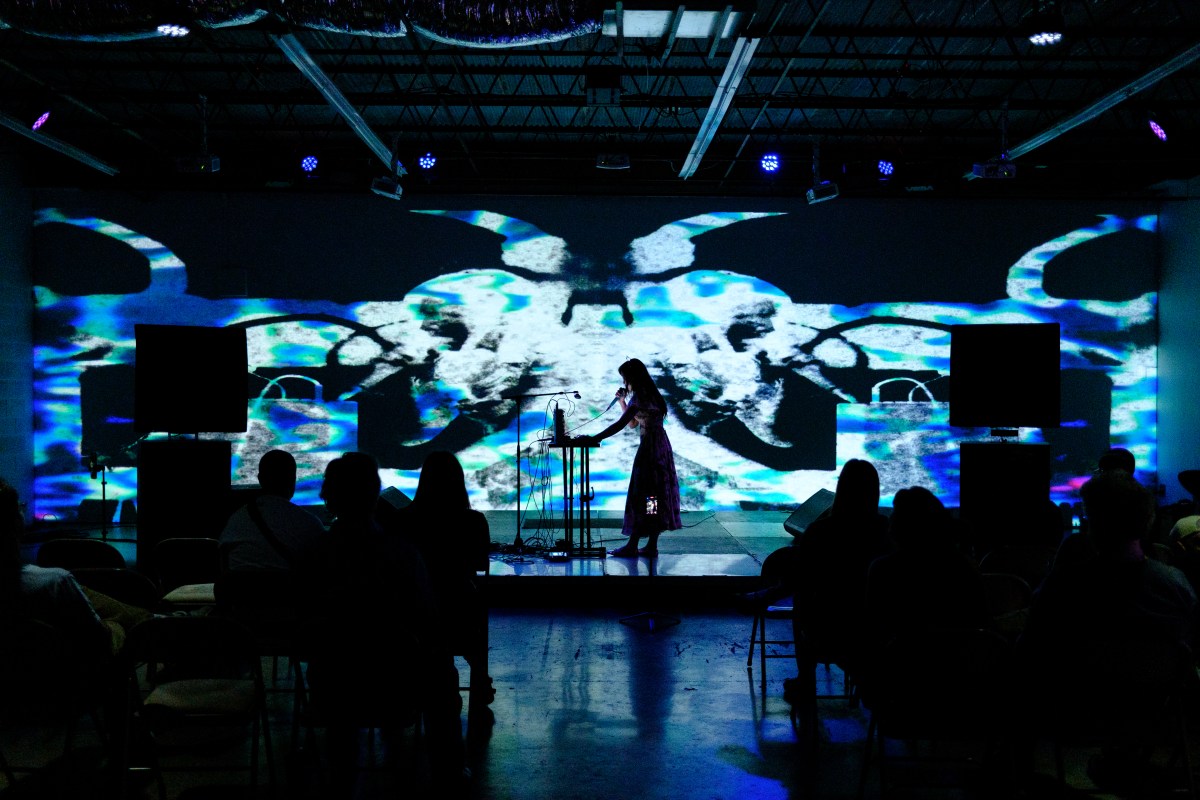
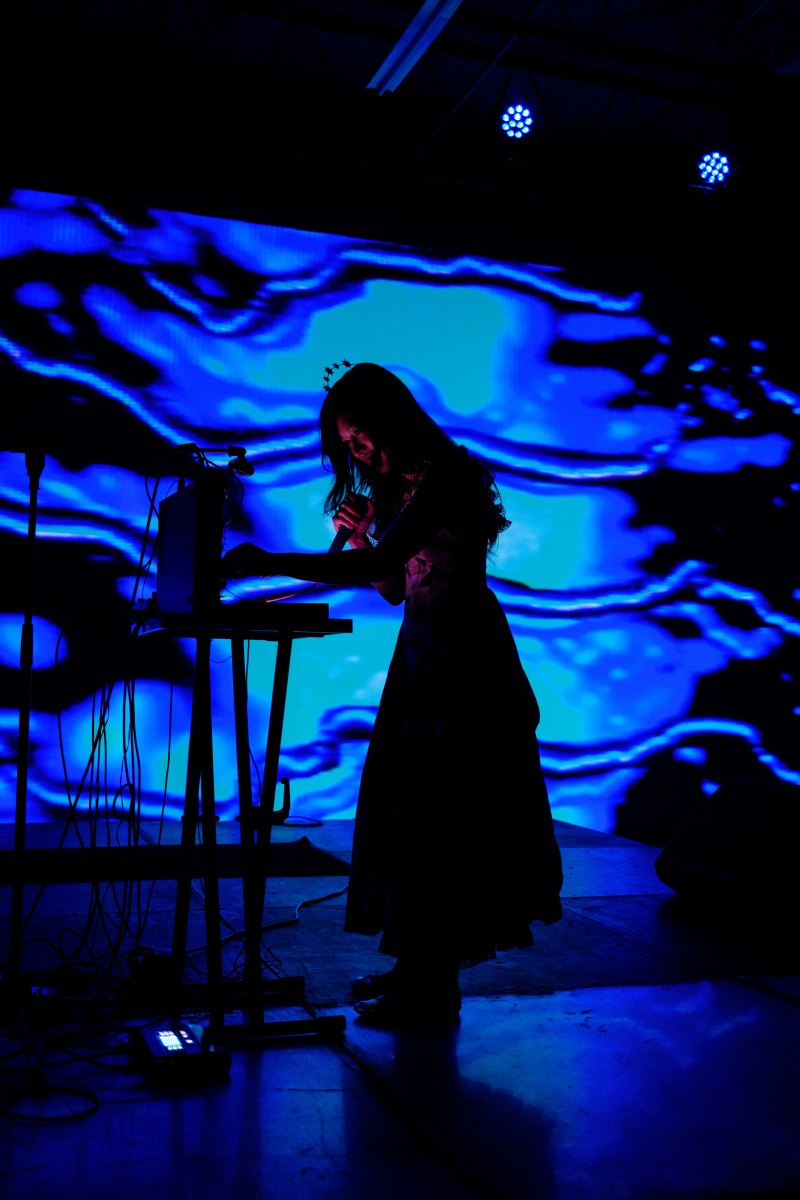
I knew right away that like I would feel very bored and unfulfilled if I were to just launch clips for a performance, so I decided that I’m going to have an instrument that I play in addition to launching clips. That way, at least there’s like some element; some possibility of messing up. I refuse to use pre-sequenced backing tracks. Launching clips is like not that far off from a backing track, but I mean, I still feel with launching clips, you have to have a very intimate awareness of what’s coming next or if you want to extend certain parts of a song versus shorten it.
I perform songs differently all the time. Maybe I’ll have like more loops or repeats in a certain thing, depending on what instrument I bring. It was violin at first, and then I was bringing out my harp. I’d play certain melodies on the violin or the harp, and now I use my keyboard synth because I can’t play string instruments right now.
I also try to take myself out of my comfort zone, doing solo harp voice sets, because I want other musicians to look at me and see that I am not just pushing buttons.
With Requiem, your fourth record as Hexpartner, have you made changes to your approach when recording?
I definitely spent a lot more time mixing it than any of my other albums.
In some ways things regressed actually because for my first three albums, I was recording vocals using just a cheap AT2020 condenser mic in my closet. But then for Requiem, I was just using a handheld SM58. I did this because I got tired of the condenser mic because it would like capture all these annoying things, like mouth clicks and like just like just mouth noises, and I got so tired of editing it.
I read forums for audio engineers and producers, and someone was saying that, for Homogenic, Bjork recorded her vocals on a handheld SM58. But of course, her voice is very powerful. Like she grew up in Iceland, like shouting and singing against the harsh wind. I don’t think my voice is powerful in that same way. But I thought, ‘Oh well, if it’s good enough for Bjork.’ There are some instances where I feel the vocals don’t sound as good as they could, but I don’t know. I hope it does not sound that way. I feel with a lot of this neoclassical stuff, it’s really the composition that is the important thing.
As long as the composition is sound, the recording can be; it can have some flaws. I don’t think there’s ever a perfect recording of anything.
Overall, there are just fewer layers. I wasn’t a very good singer when I started out, so that’s why I would initially overdub and overdub and overdub and have like so many layers and so much reverb to hide the fact that I was not a good singer. And then for this one, it’s like, ‘Well, you know, you should just accept your voice the way it is.’
I’m actually really grateful to James when he asked me to play violin for that piece that I mentioned for Fusebox Festival, he asked me to get a DPA mic for my violin, and I had no idea what it was. And I looked it up. It’s like, ‘Holy shit, this is expensive.’ But then it’s like the industry standard for strings. And so I found that using the DPA mic, if I clipped it inside of my pedal harp, the sound quality was really great. If he hadn’t asked me to get a DPA mic, then I feel like my harp would have sounded really bad.
The synth parts were recorded straight from my Deluge into my computer. I feel like that’s probably a shortcoming that I’ll have to overcome.
For the vocal parts, you are not singing in a language; it’s all unintelligible gibberish. How did that come about?
It was never really a conscious decision. It just kind of happened. I’d have placeholder sort of melodies and things, and then after some time I realized I don’t want to have to come up with lyrics because I can’t remember lyrics anyway, and I don’t like singing Latin. There’s something about Latin, the consonants of it, I just don’t enjoy singing it.
I know, I know. That’s probably blasphemy, but whatever. I guess I’m pretty consistent in the gibberish that I sing when I play the same song, but it’s never really like a conscious decision. It is about just whatever vowel sounds seem to fit the notes or the phrases. I’m not the first to do this. You know, like Elizabeth Fraser from Cocteau Twins using glossolalia. Enya actually had someone create a language for her called Locrian.
I’m not really unique in singing in gibberish, but yeah, again it all goes back to my limitations as a singer. Because, you know, my range is limited and my capacity to remember lyrics or pronounce Latin properly while singing is limited.
Do you think that not having any language in your music helps it connect with a wider audience?
I think that because there aren’t, for the most part, identifiable words or phrases, I feel that kind of leaves things up to interpretation.
Maybe it’s just like the instrumentation or the atmosphere of the song lends more to it than a lyric. There’s sometimes where the gibberish does sound like fake Latin. Like I have a track called “Recepsis Futuro,” and it’s not like real Latin, but the phrase came out that way. I guess, because I did sing some Latin at church. I just didn’t enjoy it.
What about Requiem are you particularly proud of?
When I was playing for church, it just seemed like there was this weird divide. There was a lot of contemporary Christian music, and then we’d have traditional, more Gregorian chant-sounding music. It’s just such a jarring sort of gap. I felt like there could be an intermediate step, that is clearly influenced by Gregorian chant and classical sacred music, but something that’s not quite as musically complex.
People are not as musically literate as they used to be, and I feel like I always felt like I could write things that could bridge the gap between traditional classical religious music and the crap they sing now.
Then I became agnostic. I lost my religion basically, then I guess people wanted me to play like my secular church music in other places. So I mean, so that worked out.
When did you change your views on faith?
It happened pretty soon after I stopped playing piano for church. I was 17; I was starting college at my Catholic college. I just saw so much hypocrisy and behavior that I didn’t like. Some people would party and condemn premarital sex but have it anyway, and then confess to it at Sunday Mass the next day, or the people who would pray outside abortion clinics and harass women at their most vulnerable. They all wore black when Obama was elected president. I just saw so much behavior that I didn’t like, and you know, they just used religion to justify it.
I was going to daily Mass on campus, but then the more I went, the more I was like, ‘Why am I doing this? Why am I taking an hour out of my day every day to do this when I could be studying or literally doing anything else?’ And the more I thought about it, the more I was like, ‘Is it just like social currency? Like, am I trying to establish social capital with the other tradcaths.’
It was a long time in the making, but I guess even though I stopped believing in Catholicism, the music that I was writing, I just never strayed too far from what I wanted to write for church. I wanted to compose sacred music and be a sacred music composer like Bernadette Ferrell or Bob Hurd.
Then when I lost my religion, it felt like now I had the skill that I developed that was totally useless.
But you are building an audience with it now.
I think it’s really funny, but I guess the way someone put it to me is that, if you think about it, it’s like experimental, but it’s pretty, and it’s just weird enough, but it’s not so weird that it alienates people.
What does the future of this project look like to you?
I always wanted to be a musician, but my parents scared me out of it as a career. So, I do something totally different for work. My thought is that, you know, no matter how successful I get in this niche thing, it’s never going to be anywhere close to what my day job pays. So, strictly, the music, I just see it as a way of being part of a community and pushing yourself to get better at your craft, and just finding really cool like-minded friends.
