
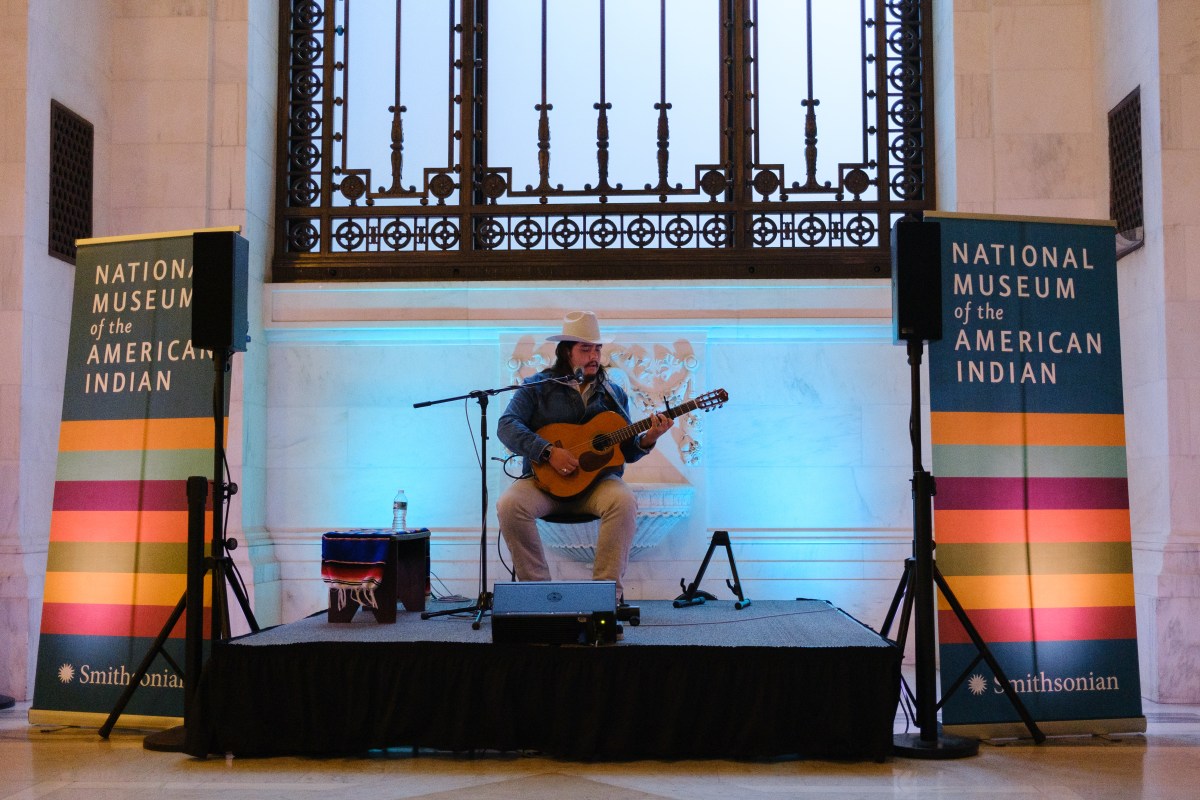
The Beaux-Arts entrance foyer of the Alexander Hamilton U.S. Custom House in Lower Manhattan is an unconventional setting for a musical performance.
Yet despite the distractions of an elaborate, two-story lobby adorned with an ornate array of colored and textured marble quarried in the United States, Italy and Switzerland, the space proved an unexpectedly intimate concert venue. The building, which stands at the southern end of Bowling Green Park, is home to the National Museum of the American Indian, as well as the U.S. Bankruptcy Court for the Southern District of New York and regional offices of the National Archives.
Agalisiga “The Chuj” Mackey stepped onto the modest stage as the autumn sun began to fade behind the lobby’s patterned glass. He had come to share his music: an earnest, deeply personal interpretation of country music, performed entirely in his ancestral language.
Sung in Cherokee, or Tsalagi Gawonihisdi (ᏣᎳᎩ ᎦᏬᏂᎯᏍᏗ), Mackey’s songs resonated through a hall built more than a century ago to serve as the Port of New York’s headquarters for the U.S. Customs Service, where officials oversaw the collection of duties and regulation of commerce.
Just steps from Wall Street, amid the visual grandeur of the building’s ornate architecture, Mackey’s voice and language commanded attention. The Oklahoma-born musician performed a selection of songs from his album, Nasgino Inage Nidayulenvi (It Started in the Woods).
Released in 2024, the album was Mackey’s debut, issued by Tulsa-based Horton Records. A subsequent pressing was released as a limited-edition gatefold on orange-smoke vinyl, accompanied by an eight-page booklet featuring translated lyrics.
The nonprofit label is dedicated to cultivating and developing artists in the Tulsa area while building on the region’s rich musical tradition.
Mackey lives in Kenwood, Oklahoma, where he teaches Cherokee language and culture to students from prekindergarten through eighth grade at the Cherokee Immersion Charter School in Tahlequah. Founded by the Cherokee Nation in 2001, the school works to preserve and revitalize the Cherokee language. In 2010, it became Oklahoma’s first Cherokee immersion charter school.
Mackey regularly participates in educational events and cultural programs across the country. His appearance at the National Museum of the American Indian offered audiences a distinctive opportunity to experience that work through music.
His Saturday, Nov. 7, performance continued the museum’s Native Sounds Downtown concert series.
The performance was intimate, but the cavernous space never overwhelmed it. Mackey took the stage without a backing band, relying instead on a nylon-string guitar and a remarkably resonant voice. Together, they proved more than sufficient to hold the audience’s attention across three sets.
Between songs, Mackey shared stories of his upbringing and his life as a husband and father. His experience as both an educator and a performer was unmistakable.
Listening to his rich, resonant voice singing in Tsalagi offered a glimpse into a culture whose history stretches far beyond the boundaries of the surrounding city.
The experience was both remarkable and thought-provoking, inviting listeners to consider the deeper histories and cultures of the Americas.
Those reflections seemed particularly fitting given the setting. Generations before the arrival of European settlers, the Lenape people inhabited Manahatta, the island now known as Manhattan. Its waterways, trails and gathering places sustained communities engaged in fishing, harvesting, trade and seasonal settlement.
Shaped by its geography, extensive trade networks and the competing ambitions of European colonial powers, Manhattan became an important center of interaction between Native American communities and European settlers. From the fur and wampum trade to the 1626 transfer of Manhattan to Dutch colonial authorities and the violence of the 1643 conflicts at Pavonia, the region’s history is marked by encounters that helped shape the colonial era and the eventual formation of the United States.
Against this sweeping historical backdrop, however, Mackey’s work as a songwriter is less concerned with documenting monumental events than with capturing the sincerity of everyday life through his own cultural perspective.
More notebook than textbook, his music explores childhood, nature and the bonds of community rather than recounting specific historical events.
In doing so, Mackey creates a connection between performer and listener that no history book alone could quite replicate. His songs offer something more personal: an opportunity to encounter a living language and culture through the ordinary experiences that give them meaning.
For that, we should all be grateful.
